



Native App vs Web App vs Website: Which One Do You Actually Need?

Simon Edward • 25 April 2026

Someone in a meeting said "we need an app." Everyone nodded. Nobody asked the follow-up question: do we actually?


This is one of the most common (and most expensive) assumption errors in business technology. The word "app" has become shorthand for "something digital that does stuff," and that vagueness costs real money. Because a native app, a web app, and a clever website are three very different things with very different price tags, timelines, and capabilities.


Here's the honest breakdown.

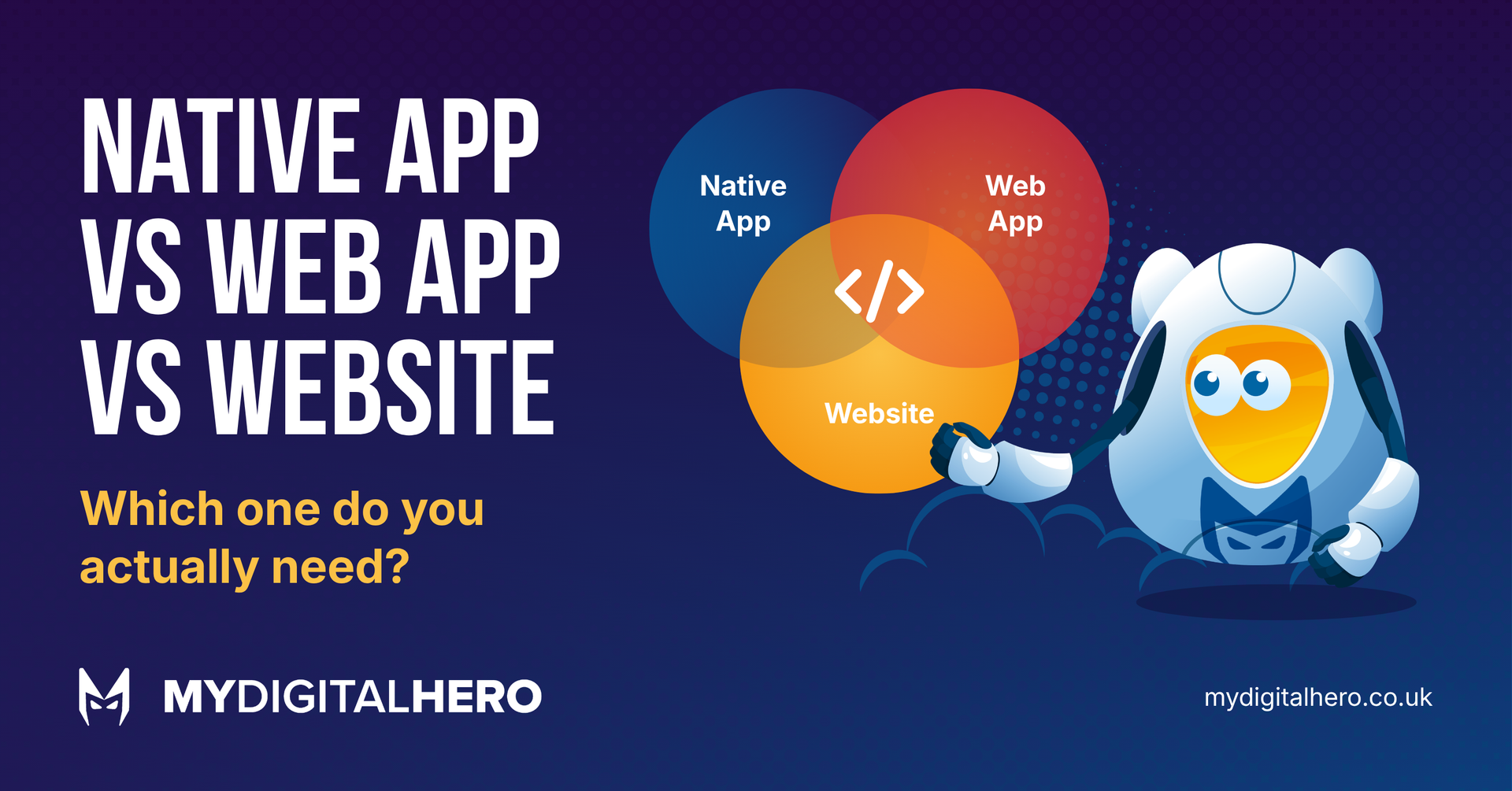
Native app vs web app vs website infographic with overlapping red, blue, and orange circles and a cartoon owl mascot

What's a Native App?


A native app is what most people picture when they say "app." It's a piece of software you download from the App Store (for iPhones) or Google Play (for Android). It lives on your phone. It can access your camera, GPS, push notifications, offline storage, biometric security, and all the other features your phone has built in.


Native apps are the most powerful option. They're also the most expensive and time-consuming to build. If you need two platforms (iOS and Android), you either build two separate apps or use a cross-platform framework like Flutter (which is what we use). Cross-platform significantly reduces cost and development time while maintaining near-native performance.


When you need a native app: Your product requires deep device integration (camera, GPS, sensors, offline mode, push notifications). Your users need the app to work without an internet connection. You're building something that needs to feel fast, responsive, and premium. You're distributing through the App Store or Google Play.


Typical investment: £60,000 to £200,000+ depending on complexity.

Hand holding a smartphone with colorful app icons on a blue abstract background, with MyDigitalHero logo

What's a Web App?


A web app lives in the browser but behaves like an app. Think of tools like Google Docs, Trello, or most SaaS platforms. You access them through a URL. There's nothing to download. They work on any device with a browser.


Progressive web apps (PWAs) blur the line further. They can be "installed" on a phone's home screen, work offline to some degree, and send push notifications. For many business use cases, a well-built PWA delivers 80 percent of what a native app does at a fraction of the cost.

When you need a web app: Your users will primarily access it from different devices and locations. You want to avoid the App Store approval process. Your features don't require deep device integration. You need faster development and lower maintenance costs. You're building an internal tool, a dashboard, a booking system, or a client portal.


Typical investment: £20,000 to £80,000 depending on complexity.

Illustration of a computer monitor with a magnifying glass over charts and UI icons on a purple background

What's a Clever Website?


A modern website can do a lot more than people give it credit for. Booking systems, client portals, payment processing, member areas, quote calculators, ecommerce, dynamic content, integrations with CRMs and accounting software. All achievable with a well-built website.

The key advantage of a website is speed and cost. A skilled web team can build something functional and beautiful in weeks rather than months. And for many businesses, a website that does clever things is all they need.


When you need a clever website: The functionality you need doesn't require device features or offline mode. Your users will access it on desktop and mobile browsers. You need something up and running quickly. Your budget is under £25,000. You want something easy to update and maintain.


Typical investment: £5,000 to £25,000.

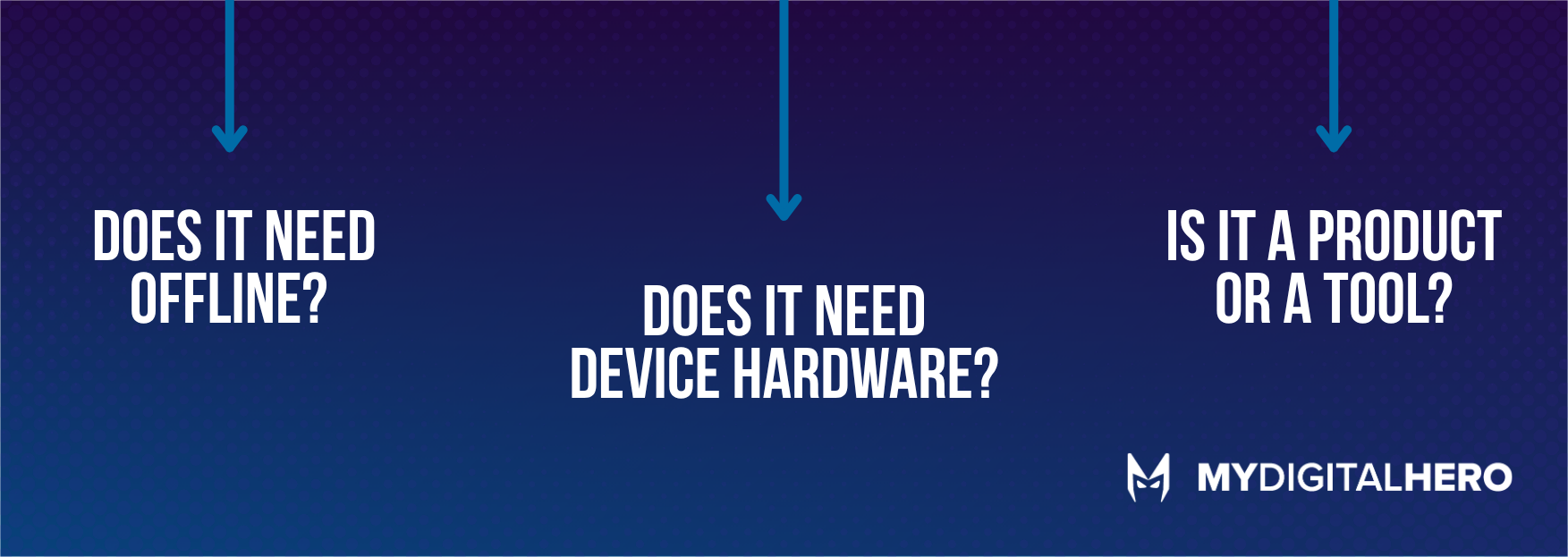
Flowchart on dark purple background asks: “Does it need offline? Does it need device hardware? Is it a product or a tool?”

The Decision Framework


The decision comes down to three questions.


Does it need to work offline? If yes, you probably need a native app or a PWA with robust offline support.


Does it need phone hardware (camera, GPS, sensors, biometrics)? If yes, native app. If no, web app or website.


Is it a product you're selling or a tool you're using? Products that customers download and use regularly benefit from native apps. Internal tools and business applications often work better as web apps.


If none of these point clearly to a native app, start with a web app or website. You can always upgrade later. Starting with the simplest solution that meets your needs saves money and gets you to market faster.


Not Sure? We Built a Tool for That


Our Scope My App tool walks you through 8 questions about your idea and generates a personalised scope report. It tells you the complexity rating, recommended approach, build phases, and estimated investment range. No email required. No commitment. Just clarity on what you actually need before you spend a penny.


Share this article

Recent Posts

How long does SEO take? Honest timelines from a Yorkshire agency:
by Alfred 24 August 2026
How long does SEO take? Honest timelines from a Yorkshire agency: what happens in months 1 to 3, 4 to 6 and beyond, and why quitting early costs you.
Most software projects do not fail because of bad code. They fail because of scope creep and a brief
by Simon Edward 8 August 2026
Most software projects do not fail because of bad code. They fail because of scope creep and a brief that never existed. Here is how to stop it happening to yours.
MyDigitalHero promo graphic: blue hero mascot and bold text, “What 8 Blogs a Month Actually Does to Your Traffic”
by Simon Edward 14 July 2026
SEO is not dead, AI just raised the stakes. Here is what eight blogs a month does for your traffic, and how AEO and SEO now work together to win.
MyDigitalHero ad with cartoon hero holding coffee and phone, saying “We Are a Small Agency. That Is the Point.”
by Simon Edward 7 July 2026
A small marketing agency in Harrogate where the person you meet does the work. No B team, no handovers, and usually the offer of a brew. Here is why.
Blue social media graphic with icons and mascot, captioned “Social Media Is Not a Strategy.”
by Simon Edward 30 June 2026
Social media strategy, lead generation and ROI explained without the jargon. Why posting alone fails, and what a real marketing system looks like.
Dark blue podcast cover with MYDIGITALHERO logo, cartoon hero, and title: “The Metric Your Boss Cares About”
by Simon Edward 23 June 2026
Vanity metrics look great and change nothing. The real marketing ROI question: money in, money out. Here is how to measure what actually matters.