What Does an App Actually Cost in 2026?

Simon Edward • 16 April 2026

If you've ever Googled "how much does an app cost," you've probably been met with the most frustrating answer in the English language:


"It depends."

If you've ever Googled

And technically, that's true. It does depend. But that answer helps nobody, and most people asking the question just want a straight number so they can figure out whether this is even worth pursuing.


So here it is. Straight numbers. Based on real UK projects, broken down by complexity, with no waffle and no hidden caveats.


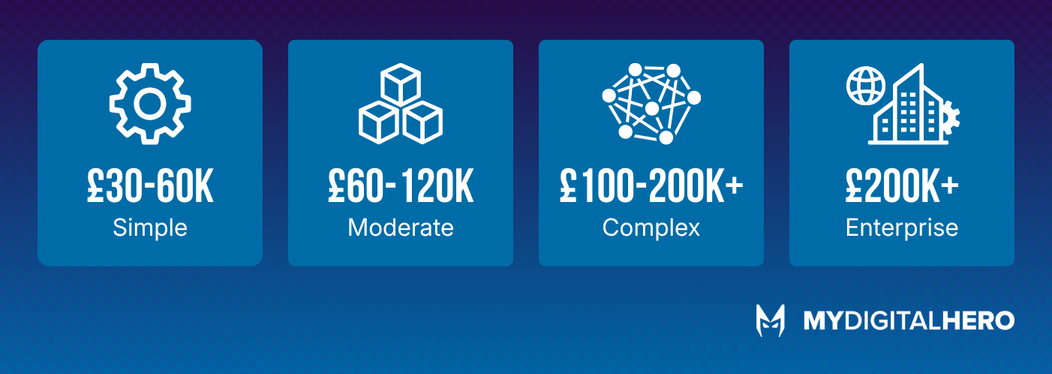
Most custom apps built in the UK in 2026 fall into one of four brackets:


Simple apps: £30,000 to £60,000 A focused tool with a handful of core features. User login, basic data display, maybe a simple admin panel. Think internal tools, MVP products, or straightforward customer-facing apps with limited functionality.


Moderate apps: £60,000 to £120,000 More features, more moving parts. Payment processing, a proper admin dashboard, integrations with one or two existing systems, push notifications. Most business apps land here.


Complex apps: £100,000 to £200,000+ Cross-platform (iOS, Android, and web), offline functionality, multiple user roles, real-time data, legacy system integrations, and compliance requirements. Health apps, financial tools, and anything handling sensitive data typically sit in this bracket.

Blue infographic showing four service tiers with white icons and prices from £30–60K to £200K+

Enterprise apps: £200,000+ Large-scale systems with heavy infrastructure. Multiple integrations, complex data architecture, thousands of concurrent users, and the kind of security requirements that keep developers up at night. These are scoped individually because no two are alike.


These aren't made-up numbers. They reflect the reality of building quality software in the UK with a team that knows what it's doing. You can find cheaper. You'll usually find out why it was cheaper about six months too late.


Why the Range Is So Wide


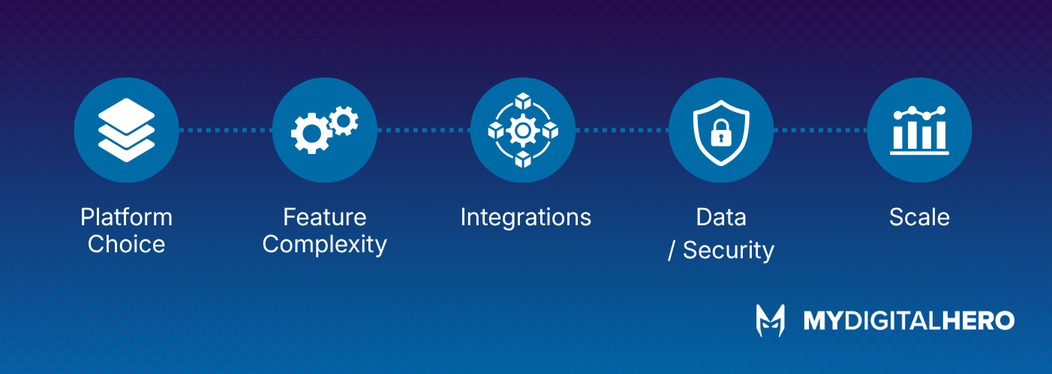
The gap between £30,000 and £200,000 isn't random. It's driven by a handful of specific factors that compound on each other.

Platform choice. Building for web only is the cheapest option. Building for mobile (iOS and Android) costs more. Building for all three costs significantly more. Cross-platform frameworks like Flutter help reduce this gap, but it's still a meaningful multiplier.


Feature count and complexity. A login screen is straightforward. A login screen with social authentication, two-factor verification, biometric support, and role-based access for five user types is not. Every feature has layers, and most people underestimate how many layers there are.


Integrations. Connecting your app to one well-documented API is manageable. Connecting it to three legacy systems that were built in 2009 and haven't been properly documented since is a different proposition entirely. Legacy integration is where budgets go to surprise people.


Data and security. If your app handles payments, health data, financial information, or personal data, the compliance requirements add cost. PCI compliance, GDPR, data encryption, penetration testing. These aren't optional extras. They're the cost of doing it properly.

Scale. An app for 50 internal users needs different infrastructure than one serving 50,000 customers. Architecture decisions made at the start determine whether the app can grow without being rebuilt.


Blue infographic with five icons labeled Platform Create, Feature Complete, Integration, Data Security, and Scale.

The Thing Nobody Talks About: Discovery


The biggest cost in app development isn't development. It's building the wrong thing.


We've seen projects arrive having already spent tens of thousands with another agency, only to realise halfway through that the scope was wrong, the features didn't match what users actually needed, and the timeline was based on wishful thinking rather than technical reality.

A discovery phase prevents this. It's typically £2,000 to £6,000 and covers user research, wireframing, technical architecture planning, and a detailed specification document. It turns a vague idea into a buildable brief.


Every successful project we've delivered started with a proper discovery phase. Every problem project we've been asked to rescue skipped one.


What About Ongoing Costs?


The launch isn't the finish line. Every app needs ongoing maintenance, hosting, bug fixes, security updates, and iteration based on user feedback. Budget roughly 15 to 20 percent of the initial build cost per year for maintenance. If your app cost £100,000 to build, plan for £15,000 to £20,000 per year to keep it running properly.


Hosting costs vary depending on scale and infrastructure, but for most apps they range from £100 to £2,000 per month. We host on DigitalOcean's UK servers using Docker and Kubernetes, which gives solid performance without the eye-watering bills that come with some cloud providers.


How to Get a Realistic Estimate for Your Idea


Every app is different, so the most useful thing you can do is get a scope report specific to what you want to build. We've built a free tool that does exactly this.


Answer 8 questions about your idea and it generates a personalised scope report covering complexity rating, recommended build phases, estimated investment range, and the key risks worth knowing about. No email required. No sales call. Just clarity.



If you'd prefer to talk it through with a human, you can book a discovery call with us. No commitment, no pressure. Just an honest conversation about what you're trying to build and what it would realistically take to get there.


What We Build With


Our tech stack is built for quality and longevity. We use Laravel on the backend, Vue.js for web interfaces, Flutter for cross-platform mobile apps, MySQL and MongoDB for databases, Redis for caching, Docker and Kubernetes for deployment, and DigitalOcean UK servers for hosting. Everything is modern, maintainable, and built to scale.


We don't use templates. We don't outsource to offshore teams. We don't cut corners on architecture to hit a lower price point. Good development isn't cheap. But cheap development is the most expensive mistake you'll make.

Share this article

Recent Posts

SEO explainer graphic with Google search bar, upward arrows, and a cartoon robot on a blue background
by Simon Edward 25 April 2026
Understand SEO & its impact on your business. Get key strategies for success. Contact My Digital Hero for expert support!
Tech Stack Graveyard poster with a blue robot among tombstones on a purple night background
by Simon Edward 25 April 2026
Explore our interactive graveyard for dead tech like Adobe Flash & Internet Explorer. Join us in remembering the tech that shaped the web!
Infographic comparing native app, web app, and website with colorful circles and a cartoon robot mascot
by Simon Edward 25 April 2026
Understand the differences between native apps, web apps & websites. Choose the right solution for your business needs today!
Blue infographic with a cartoon owl and six coin icons, titled “The 6 Types of Business Owner We Meet.”
25 April 2026
Identify 6 business owner types & discover how a marketing partner can boost your growth. Contact us for tailored solutions!
Blue marketing infographic with the title “10 Reasons Not to Do Marketing” and a cartoon character holding a 10 sign
by Simon Edward 25 April 2026
Explore why avoiding marketing is harmful for businesses. Contact us to enhance your marketing strategy today!
Abstract multicolor gradient background in green, blue, and purple tones
by Simon Edward 25 April 2026
Avoid costly app development errors by defining your project clearly. Invest in a thorough discovery phase for success.