


Marketing Jargon Explained: Every Term You Need to Know
Marketing has a language problem. Not a creativity problem. Not a strategy problem. A language problem.
Walk into any meeting with a marketing agency and within five minutes someone will mention CTR, CPA, ROAS, organic reach, bounce rate, and conversion funnels. Everyone nods. Nobody asks what any of it means because they don't want to be the one who admits they're lost.
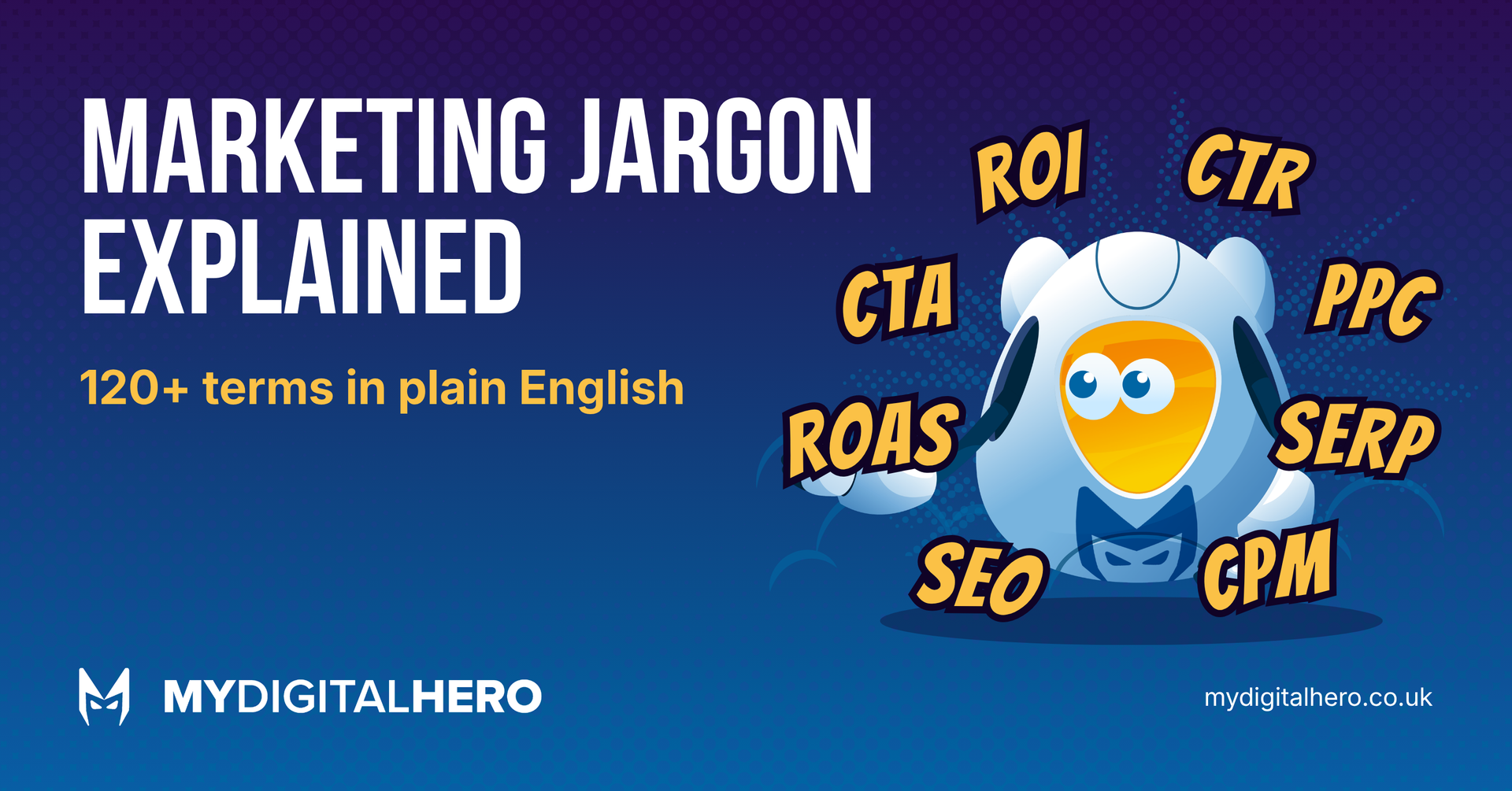
This guide fixes that. Every major marketing term, explained in plain English, by people who think jargon is the enemy of good communication.
We've also built an interactive version of this guide on our website. It's called the Jargon Buster. 120 terms, each with a plain English explanation and a one-liner from Alfred, our robot mascot. You can search, filter by category, and finally stop pretending you know what CPC means.

Advertising Terms
PPC (Pay-Per-Click): You pay every time someone clicks your ad. Usually on Google or social media. If your ads are set up well, those clicks become customers. If not, you're paying Google to send you window shoppers.
CPC (Cost Per Click): The actual amount you pay each time someone clicks your ad. Varies wildly depending on your industry and competition. Some clicks cost 30p. Some cost £30.
CPM (Cost Per Mille): What you pay for every 1,000 times your ad is shown. You're paying for eyeballs, not clicks. Good for brand awareness, less good if nobody actually looks at it.
CPA (Cost Per Acquisition): How much it costs you to actually get a customer, not just a click. This is the number that matters.
CTR (Click-Through Rate): The percentage of people who see your ad and actually click it. If your CTR is low, your ad is either boring, badly targeted, or both.
ROAS (Return on Ad Spend): How much revenue you make for every pound you spend on ads. A ROAS of 5 means you made £5 for every £1 spent.
Google Ads: Google's advertising platform. You bid on keywords so your business appears at the top of search results. The most direct way to get in front of people who are already looking for you.
Meta Ads: Advertising on Facebook and Instagram. Good for reaching people who aren't searching for you yet but match the profile of your ideal customer.
Retargeting: Showing ads to people who've already visited your website. They looked but didn't buy. Retargeting is your polite nudge.
Conversion: When someone does the thing you wanted them to do. Buys something, fills in a form, makes a call. The whole point of marketing.
Landing Page: A standalone web page built for a specific campaign. Its only job is to get visitors to take one action. No distractions. A good landing page is a one-way street to "yes."
CTA (Call to Action): The bit that tells someone what to do next. "Book a call." "Get a quote." Without a clear CTA, people read your content, nod politely, and leave.
A/B Testing: Running two versions of something at the same time to see which performs better. Change one thing, measure the difference, keep the winner.
SEO Terms
SEO (Search Engine Optimisation): Making your website show up when people search for what you do on Google. It takes time, it compounds, and it's the closest thing to free marketing that exists.
Keywords: The words and phrases people type into Google. Your job is to figure out which ones your customers use and make sure your website shows up for them.
Organic Traffic: Visitors who find you through unpaid search results. No ad spend involved. The holy grail of sustainable marketing.
SERP (Search Engine Results Page): The page you see after you Google something. The first page is prime real estate. The second page is where websites go to be ignored.
Backlink: When another website links to yours. Google sees this as a vote of confidence. More quality backlinks means higher rankings. A link from the BBC is worth more than a link from Dave's Blog.
Domain Authority: A score out of 100 that predicts how likely your website is to rank. Think of it as your website's credit score.
On-Page SEO: Everything you do on your website to help it rank. Title tags, headings, content quality, internal links. The stuff you can control directly.
Off-Page SEO: Everything that happens away from your website that affects ranking. Mainly backlinks and brand mentions. Harder to control, but powerful.
Technical SEO: The behind-the-scenes stuff. Site speed, mobile-friendliness, sitemaps, structured data. Nobody sees the plumbing, but when it breaks, everyone notices.
Local SEO: Optimising your business to appear in local search results and Google Maps. If you serve a local area, this is the single most important thing you can do.
Google Business Profile: Your free business listing on Google. Shows up in Maps and local search. If you haven't claimed yours, stop reading and go do it now.
Meta Description: The short snippet under your page title in search results. Doesn't directly affect ranking, but affects whether people click.
Bounce Rate: The percentage of visitors who land on your site and leave without doing anything. They came, they saw, they left. Find out why.
Long-Tail Keywords: Longer, more specific search phrases. "Running shoes" is short-tail. "Best running shoes for flat feet women" is long-tail. Less volume, much higher intent.
Social Media Terms
Engagement: Any interaction with your content. Likes, comments, shares, clicks. Followers are vanity. Engagement is sanity.
Reach: The number of unique people who saw your content. Different from impressions, which counts total views.
Algorithm: The invisible rules that decide what content gets shown to whom. Nobody fully understands them. They change constantly.
UGC (User-Generated Content): Content created by your customers. Reviews, photos, testimonials. More trusted than anything your marketing team could create.
Social Proof: Evidence that other people trust your business. Reviews, testimonials, client logos. Nobody wants to be your first customer.
Engagement Rate: The percentage of people who saw your content and interacted with it. More useful than raw follower count.
Analytics Terms
ROI (Return on Investment): How much you made compared to how much you spent. The only metric that matters when someone asks "is our marketing working?"
KPI (Key Performance Indicator): The numbers you track to know if something is working. If everything is a KPI, nothing is a KPI. Pick 3 to 5 that matter.
Google Analytics: Google's free tool for tracking what happens on your website. If you don't have it installed, you're flying blind.
Conversion Rate: The percentage of visitors who take a desired action. Small improvements here have outsized impact. Doubling your conversion rate is often easier and cheaper than doubling your traffic.
Funnel: The journey from stranger to customer. Awareness, interest, consideration, decision. People drop off at each stage. Your job is to plug the leaks.
CAC (Customer Acquisition Cost): The total cost of getting one new customer. If it costs more to get them than they're worth, you have a problem.
LTV (Lifetime Value): How much a customer is worth over their entire relationship with you. Stop thinking about the first sale. Start thinking about the hundredth.
Email Marketing Terms
Open Rate: The percentage of people who open your email. If it's low, your subject lines aren't working.
Segmentation: Splitting your email list into groups based on shared characteristics. Different groups get different messages. Relevance beats volume.
Automation: Emails that send themselves based on triggers. Set it up once, it runs forever. Your most reliable employee.
Drip Campaign: A series of automated emails sent over time. The slow, persistent friend who eventually convinces you.
Web Development Terms
CMS (Content Management System): Software that lets you manage a website without writing code. WordPress, Duda, Wix.
UX (User Experience): How easy and pleasant your website is to use. If people can't figure it out in 5 seconds, they won't try for 6.
Responsive Design: A website that adjusts to look good on any screen. More than half your visitors are on their phone. Your website needs to work on their phone.
Page Speed: How fast your website loads. Anything over 3 seconds and you're losing visitors. Google uses it as a ranking factor too.
SSL Certificate: The padlock in your browser bar. Means data is encrypted. Without it, Google warns people not to trust your website.
Strategy Terms
Brand Awareness: How familiar people are with your business. You can't buy from a business you've never heard of.
Target Audience: The specific group most likely to buy from you. "Everyone" is not a target audience.
USP (Unique Selling Proposition): The one thing that makes you different. If you sound like everyone else, people choose whoever's cheapest.
Content Marketing: Creating useful content to attract customers. Instead of shouting "buy our stuff," you earn attention by being genuinely helpful.
B2B (Business to Business): Selling to other businesses. Longer sales cycles, more decision-makers. Marketing needs to build trust.
B2C (Business to Consumer): Selling to individuals. Shorter decisions, more emotional triggers.
Tone of Voice: How your brand sounds in writing. If your LinkedIn sounds corporate and your Instagram sounds like a teenager, your brand has a personality disorder.
The Weird Ones
Dark Social: When people share content through private channels like WhatsApp and DMs. You can't track it, but it drives more traffic than you'd think.
Zero-Click Search: When Google answers the question on the results page so nobody clicks through to any website. Google is getting better at stealing your traffic.
Growth Hacking: A buzzword for finding clever ways to grow quickly. It's just good marketing with a trendy name.
Synergy: A perfectly valid concept ruined by being used in every meeting without meaning anything specific. If someone says synergy and can't define it, leave the meeting.
SaaS (Software as a Service): Software you pay for monthly instead of buying. Netflix is SaaS. Mailchimp is SaaS. You're renting, not buying.
Want the Interactive Version?
We've built every one of these terms (and 80 more) into an interactive tool on our website. Click any term, get the plain English explanation, and find out how many other people have pretended to know what it means.
Recent Posts